



Cost of Manufacturing in Mexico: Complete Guide (2026)
23 min Read
Key Takeaways
- Tetakawi's October 2026 average starting cost for an unskilled operator is $5.19 per scheduled hour, fully fringed, at 18.5 MXN/USD, on the 46-hour week that begins in January 2027.
- Modeled employer-cost estimates for comparable occupations are $32.12 an hour in the United States and $18.97 in Canada; a plant comparison also needs matched roles, staffing and output.
- Industrial asking rent in Mexico averages about $0.71 per square foot a month as of September 2026, per Solili, about 17% below the U.S. and 19% below the Canadian published averages.
- For a first budget, Tetakawi plans electricity at about $0.13 per kilowatt-hour and water at about $17.30 per 1,000 gallons at 18.5 MXN/USD; both are planning assumptions, not quotations.
- Tetakawi has helped manufacturers operate in Mexico since 1986 and builds the cost model around your workforce, shifts, facility, utility demand and supply routes before you commit.
Jump to Section
To estimate the cost of manufacturing in Mexico for your operation, start with a defined production plan: output, headcount, shifts, equipment and material flows. Then price the people, space, utilities, logistics and administrative support that plan requires. Labor can make a large difference, and the investment decision still rests on the full cost of producing and delivering your product.
This guide brings together Tetakawi’s October 2026 Campus labor benchmarks, published industrial property and electricity data, and the planning assumptions Tetakawi uses for a Mexico operation. Each figure carries its period and its basis. The five operating-cost categories below are inputs to combine with your own material, equipment and working-capital assumptions. Each one sits inside the wider picture of manufacturing in Mexico.
$5.19/hr
operator, fully fringed, Oct 2026
$0.13/kWh
electricity planning assumption
46 hours
standard workweek from Jan 2027
What Does It Actually Cost to Manufacture in Mexico?
Raw materials, purchased parts, depreciation and selling costs vary too much by product to sit in a general table, so the table below leaves them out. It covers the five local operating-cost categories you price when you choose where and how to run a plant in Mexico. They are in the order a budget is usually built.
| Operating-cost category | What sits inside it | Where the 2026 figure comes from |
|---|---|---|
| Labor | Wages with the benefits and contributions the law requires, for direct, indirect and salaried roles | Tetakawi’s October 2026 Campus averages, by role |
| Industrial space | Rent or facility charge, property tax, building insurance, upkeep, fit-out | Solili asking rents, September 2026; varies by corridor and building |
| Logistics | Inbound materials, local freight, the northbound crossing, brokerage per entry | Your routes, shipment frequency and consolidation plan |
| Utilities | Electricity, water and sewer, natural gas, connectivity | Tetakawi planning assumptions at 18.5 MXN/USD; EIA for the U.S. comparison |
| Administration and compliance | Accounting, customs and trade compliance, environmental and safety programs, training | The shelter arrangement, or your own staff and outside providers |
Which category is largest depends on the process. Labor and industrial property costs vary by corridor. Compare them using your required roles and facility specifications. Electricity follows the federal tariff schedules; water, gas and connectivity each have their own pricing. Keep three kinds of money apart as you build the model: recurring operating cost, one-time set-up spending, and working capital.
How manufacturers reduce manufacturing costs in Mexico
The savings are not in the wage alone. They come from choices, and each one has a section on this page. The corridor: wage levels, the statutory floor and the competition for workers differ by region. The shift design: the workweek steps down from 2027 to 2030, and overtime limits change with it, so plan shifts for the year you will run them. The building: a standing building with its power, lighting and offices in place removes months of fit-out and the set-up spending that goes with it. The shared teams: compliance, customs, HR and facilities staff that serve several operations reduce the need to build each function alone. The working capital: the VAT route you operate under decides how much cash each import ties up. The route: shorter transit takes inventory out of the pipeline.
Manufacturing Labor Costs in Mexico: Beyond the Hourly Wage
Most of what a search returns for Mexican wages is what a worker is paid. It is a salary offer, or a national average across the whole economy. A plant budgets something different: the fully fringed employer cost, also called fully burdened or fully loaded. It is the wage plus the benefits and contributions Mexican law requires, converted to one hourly rate.
The conversion matters because of how Mexico pays. In Mexico, manufacturing pay is commonly quoted in pesos per day. For the full-year payroll model used here, the daily amount is annualized over 365 paid calendar days, including paid rest days and holidays. So an hourly employer cost has to account for the paid days and for the scheduled hours used in the model. Dividing the daily wage by eight hours understates the hourly wage by about a fifth, before anything is added to it. The arithmetic, on a hypothetical 400-peso day with each legal layer shown, is in how a daily wage becomes an hourly employer cost.
What the roles cost in 2026
The figures below are the average starting employer cost across the five Tetakawi Manufacturing Campuses in Saltillo, Hermosillo, Guaymas, Empalme and Mazatlán, as of October 2026. Each is the employer’s cost with the benefits and contributions Mexican law requires on top of the wage. The unit is U.S. dollars per scheduled hour at 18.5 pesos to the dollar, on the 46-hour week. Most companies evaluating Mexico today are planning a 2027 start, so we show rates on the week that will apply then rather than on today’s 48. The schedule adjustment is already in these figures. Sixteen roles across direct, indirect and salaried work are in Manufacturing Labor Costs in Mexico: 2026 Wage Benchmarks.
| Role | Avg. starting rate, fully fringed (USD/hr) |
|---|---|
| Unskilled operator | $5.19, about $1,030 a month |
| Quality control inspector | $7.71 |
| Maintenance technician | $10.28 |
| CNC machinist | $11.17 |
| Manufacturing engineer | $18.84 |
| Plant manager | $61.27 |
Mexico against the United States and Canada, role by role
The comparison below puts the Mexican figures beside modeled employer-cost estimates for the United States and Canada. Each foreign figure is the published median wage for a comparable occupation, multiplied by that country’s manufacturing ratio of total compensation to wages. So all three columns describe the cost of employing the person rather than the pay.
| Role | Mexico, avg. starting employer cost | United States, modeled employer cost | Canada, modeled employer cost | Mexico lower than the U.S. by | Than Canada by |
|---|---|---|---|---|---|
| Unskilled operator | $5.19 | $32.12 | $18.97 | 84% | 73% |
| CNC machinist | $11.17 | $42.25 | $28.45 | 74% | 61% |
| Manufacturing engineer | $18.84 | $73.68 | $41.94 | 74% | 55% |
The effect on your budget depends on how many people you need in each role and the output they support. Build the staffing plan first, then compare the cost of delivering the same volume at each location. The role-by-role analysis is in Average Labor Costs in Mexico vs. United States, and the comparison with China is in Manufacturing Wages: Mexico vs. China.
Two rules that move the labor figures
The first is the minimum wage. CONASAMI set the 2026 minimum wage at 315.04 pesos a day in the general zone and 440.87 in the northern border free zone. It has raised the general-zone floor by double digits every January since 2019. The Tetakawi Campuses sit in the general zone. Each increase lifts starting rates, and that is how it reaches a payroll. CONASAMI sets the January 2027 figure in December, so a 2027 budget should carry a step. The year-by-year table is in Minimum Wage in Mexico 2026: Rates and Impact on Manufacturing.
The second is the workweek. A constitutional reform published March 3, 2026 takes the standard week from 48 hours to 46 in 2027, 44 in 2028, 42 in 2029 and 40 in 2030. Pay does not fall because of the change. Holding annual employer cost constant, each step raises cost per scheduled hour by about 4% to 5%. The benchmarks on this page already use the 46-hour schedule. A multi-year model should carry the later steps, wage changes and the staffing needed to hold output. Overtime limits change through the transition as well. The weekly allowance for double-time overtime is nine hours in 2026 and 2027, ten in 2028, eleven in 2029 and twelve in 2030, with up to four further hours a week at triple time. The shift rules, breaks and premiums are in our guide to working hours, shifts and overtime in Mexico. The transition year by year is in Mexico’s 40-Hour Workweek.
What the law requires on top of the wage, benefit by benefit, is in our overview of holidays, leave and statutory benefits in Mexico. Severance is set by Mexican law and belongs in the model from the day headcount is planned. It is worked through in What Shelter Services Cost in Mexico.
Industrial Real Estate and Facility Costs
Industrial asking rents in Mexico are commonly quoted in U.S. dollars per square meter per month. For planning, treat the headline rate as the charge for space and check property tax, insurance and maintenance separately. U.S. triple-net asking rates also exclude those operating expenses from the quoted base rent. Compare specific buildings on the same scope before comparing the total cost.
What the market charges in 2026
As of September 2026, the average industrial asking rent across the fifteen markets Solili tracks was $7.67 per square meter a month. That is about $0.71 per square foot, up 5% on a year earlier. National vacancy was 5.5% on an inventory of 115 million square meters.
The spread runs from about $0.50 in Guanajuato to $0.96 in Mexico City. Saltillo was at $0.67, Monterrey at $0.66 and Tijuana at $0.81. Rents vary by corridor and building. Solili does not publish averages for Sonora or Sinaloa, where four of the five Tetakawi Campuses sit. Rents there move with the corridor, the building and its age, and we price them for a specific building. Ask us for current figures for Hermosillo, Guaymas, Empalme and Mazatlán. The city-by-city table, the definitions, and how to normalize a quotation are in industrial rent benchmarks by city.
Converted to U.S. dollars per square foot per month, the published Mexican average is about 17% below the U.S. average shown here and 19% below the Canadian one. The three series cover different inventories, periods and expense definitions. Use them to frame the market, then compare specific buildings on the same delivered scope and operating expenses.
| Market | Published rate | USD per sq ft a month | Period and basis | Source |
|---|---|---|---|---|
| Mexico, 15 markets | $7.67 per m² a month | $0.71 | September 2026, asking rent | Solili |
| United States | $10.32 per sq ft a year | $0.86 | Q2 2026, asking rent, NNN | Cushman & Wakefield |
| Canada | C$14.77 per sq ft a year | $0.88 | Q3 2026, net asking rent, excluding TMI | CBRE, at the Bank of Canada’s September 2026 average of C$1.3962 |
What sits above the rent
In practice, the differences above rent are where budgets go wrong. A Mexican asking rent as published does not state whether property tax, building insurance and common-area maintenance are inside it, so check each one. The same goes for the office build-out, the production lighting, the transformer and panel sized for your load, and the air conditioning. Then the upkeep of all of it. Each is quoted or assumed separately, and a building that looks cheap per square foot can arrive as a shell. Treat a headline rate as a space-only planning input until the written offer confirms what it includes and who maintains it.
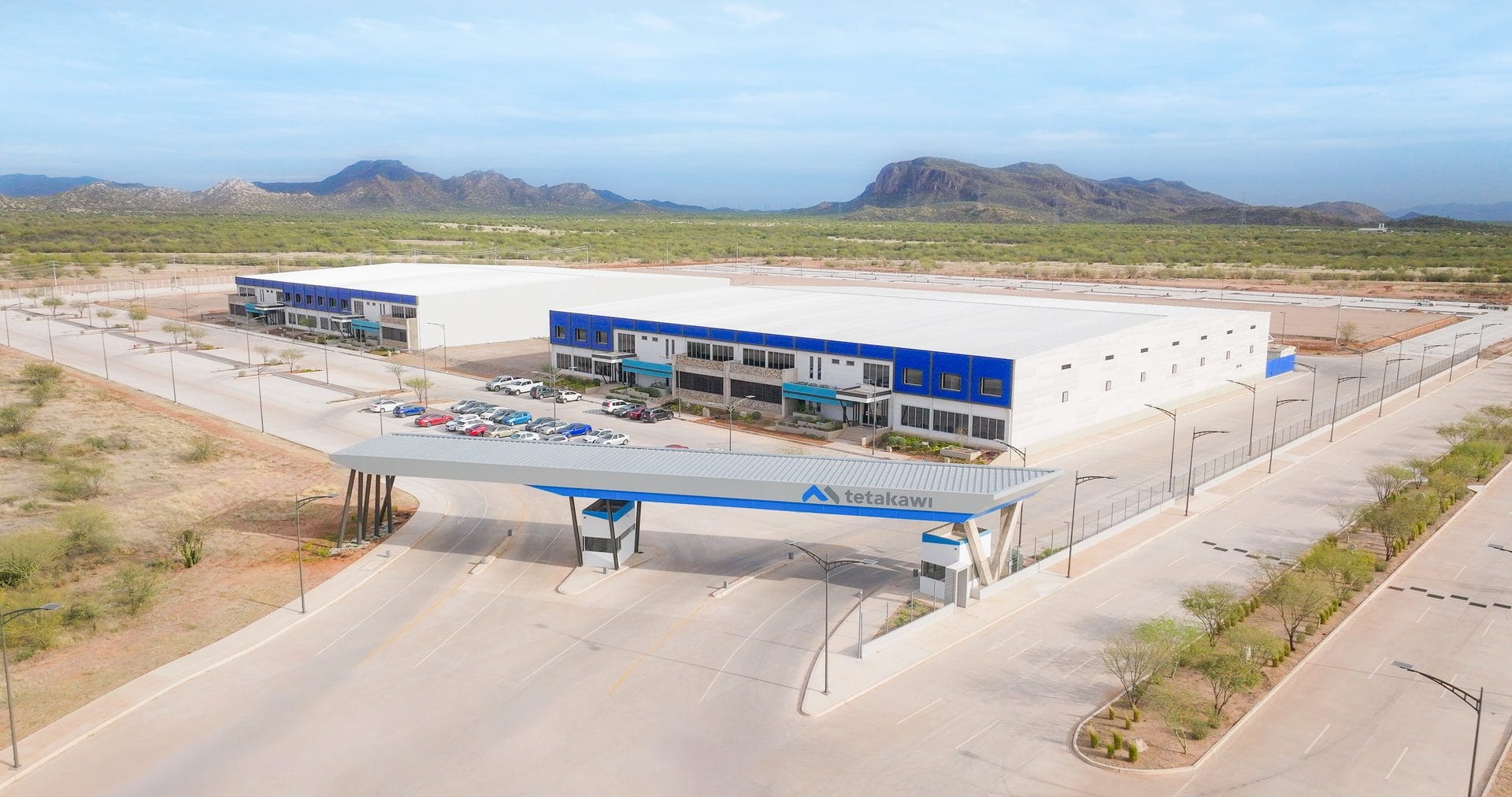
On a Tetakawi Manufacturing Campus the building is standing, with its docks, production floor, lighting, air conditioning, offices and restrooms in place. Its maintenance, repairs and replacement stay Tetakawi’s job after move-in. So the comparison is between delivered buildings, with the headline rent as one line in it. Utility consumption, production-specific improvements and process equipment stay in the manufacturer’s budget. What a Campus building costs depends on the corridor and the building, so we price it with you against your own space and power needs. What the industrial space on a Campus includes, building by building, is on that page.
One-time set-up costs
Then there is the money spent before the first shift, which a budget that stops at rent and payroll misses. Electrical capacity can be a significant set-up cost. A new connection, or an increase in contracted demand, may require network works and an upfront contribution to CFE, the federal utility. The amount depends on the site, the capacity available and the utility’s assessment of the project. Budget separately for the deposit, for the certified inspection of the installation, and for the installation work itself. Under the standard medium-voltage supply contract, the deposit is capped at one billing period’s average charges. Grid-code and verification requirements depend on the installation’s voltage and demand and belong in the project schedule.
Beyond the service entrance come the compressed-air loop, the process-water loop and any softening, and the gas connection with its deposit. Then the environmental, safety and discharge permits and studies, each with its own agency and fee. Where the process needs a compressor, a chiller or a cooling tower, the major brands are sold and serviced in Mexico. Surplus units can be brought in from the United States under the applicable temporary-import authorization. The itemized list, with the permits by agency, is in Start-Up Costs for Expanding to Mexico.
On a Campus, the service entrance, the transformer sized for the building and the permits that attach to the building are already in place. That is why the set-up budget for an operation there is shorter than the list above. Process-specific approvals, utility requirements and equipment are assessed for each project, with responsibilities assigned under the operating arrangement.
Utility Costs for Manufacturing in Mexico
Electricity
Electricity is usually the largest utility line. For an initial budget, Tetakawi uses approximately $0.13 per kilowatt-hour at 18.5 pesos to the dollar, including an allowance for demand charges. It is a blended planning assumption based on March 2025 utility inputs from the Tetakawi Campuses, converted at the stated exchange rate and retained for October 2026 planning. At that rate a plant using 100,000 kilowatt-hours a month budgets about $13,000 a month for electricity. A project estimate uses the equipment load, the operating schedule, the demand profile and the tariff that applies at the site.
The Energy Information Administration published U.S. industrial rates for July 2026. Beside them, the Tetakawi assumption sits two cents above Ohio, one cent above Illinois, higher than Texas and Arizona, and well below California.
| Market | Industrial rate, USD per kWh | Basis |
|---|---|---|
| Mexico, Tetakawi planning assumption | $0.13 | Blended, at 18.5 MXN/USD; includes an allowance for demand charges |
| Texas | $0.071 | EIA, July 2026, average industrial price |
| Arizona | $0.094 | EIA, July 2026 |
| United States average | $0.098 | EIA, July 2026 |
| Ohio | $0.110 | EIA, July 2026 |
| Illinois | $0.119 | EIA, July 2026 |
| California | $0.251 | EIA, July 2026 |
Before production begins, the plant also needs enough contracted electrical capacity. New connections and increases can require an upfront contribution and installation work. On a Campus some of that capacity is already in place, and what is allocated to a project is confirmed before the budget is set.
Water, gas and connectivity
For water, Tetakawi uses a planning allowance of about $17.30 per 1,000 U.S. gallons, including the model’s provision for sewer charges. Local sanitation charges and any treatment the process requires are checked separately. Supply is the question to ask before the rate. Several northern and Bajío markets face water stress, so a water-intensive process should confirm availability and discharge terms before committing to a site. Natural gas is quoted in dollars per MMBtu delivered, with the commodity, transport and capacity charges requested together. There is no useful national average. The gas network does not reach every industrial corridor, so confirm access before a process that depends on it is sited. Connectivity is quoted per circuit. How the federal tariff is built, demand charges, power factor and the regional divisions are in industrial electricity and utility rates in Mexico.
How Mexico Compares: Manufacturing Costs vs. the US and China
Against the United States and Canada, the labor table above shows the size of the difference by role. Against China, wages are only part of the comparison; distance to the customer carries much of the rest.
Logistics speed and cost
Mexico’s proximity to North American customers can reduce transit time and inventory in transit. Compare freight from each candidate plant to the same customer destination, including collection, border or port handling, customs clearance and inland delivery. Use equivalent shipment sizes and defined clearance assumptions. Price the Mexican route by truckload and customs entry; shipment frequency and consolidation determine the entry count.
Transit time also affects the cash tied up in inventory and its financing cost. Take a hypothetical plant shipping $1 million of product a month at inventory cost, with 35 days in transit from Asia against three from Mexico. The Asian pipeline holds about $1.2 million in transit at any time. At a 10% annual financing rate, the 32-day difference is about $105,000 a year in financing alone. Storage, insurance and the cost of a line stopped by a late shipment come on top. You can also ship smaller lots more often. How Tetakawi runs the northbound lane from each Campus is on the import and export page.
Tariffs and the USMCA
Under the USMCA, goods that are properly entered under its preference enter the United States free of the ordinary duty. What applies beyond that has moved several times since 2025. Whether your product qualifies, and what the current measures mean for it, is a question for trade counsel on your bill of materials. Carry tariffs in the model as scenarios. What manufacturers should prepare for as the agreement is reviewed is in the 2026 USMCA review.
Where in Mexico Should You Manufacture? Regional Cost Comparison
Mexico is several labor markets. The northern border has its own minimum wage, 40% above the general zone’s. Hundreds of export plants in Tijuana and Ciudad Juárez compete there for the same workers. Monterrey is a corporate and large-employer market, with asking rents just below the national average. The Bajío combines mature automotive supply chains with rents below the national average. A statutory floor does not set market pay for every role, so price each corridor on your own roles.
The Tetakawi Campuses sit in Coahuila, Sonora and Sinaloa, in the general minimum wage zone, and that is what the averages on this page reflect. Each corridor has its own workforce. Saltillo’s metro area had an economically active population of about 516,000 in the second quarter of 2026, per INEGI. Manufacturing employs 30% of Coahuila’s workers. Hermosillo’s metro area had about 457,000, and Sonora’s manufacturing share is 19%. Those are workforce context, not a count of people available to hire this quarter. Guaymas and Empalme share one labor market on the Sonora coast, with an aerospace cluster around the Roca Fuerte and Bella Vista Campuses. Mazatlán is a Pacific port with its own Campus and labor market. Each Campus page carries that location’s own figures and workforce: Zapa in Saltillo, Rio Sonora in Hermosillo, Roca Fuerte in Guaymas, Bella Vista in Empalme and Mazatlán.
The lowest rate is rarely the best value on its own. Assess recruitment, staffing and the cost of the shift pattern you plan to run. Add the building each corridor can deliver, and the routes to your suppliers and your customer. The answer often differs from the one a wage table gives.
How the Shelter Model Affects Your Cost Structure
Many foreign manufacturers enter Mexico under a shelter arrangement and form no Mexican company of their own on day one. Under this arrangement the plant operates inside the provider’s Mexican operations. Those operations hold the registrations, employ the workforce on the manufacturer’s behalf and run customs, payroll and compliance, while the manufacturer runs production.
For manufacturers operating under Tetakawi’s shelter arrangement on a Manufacturing Campus, Tetakawi’s Mexican operations handle employment, payroll administration and statutory benefits. Your team does not need to establish a separate local payroll function for those activities. The arrangement also provides customs and administrative support while you run the manufacturing operation. You control production, process and quality. Tetakawi is not a contract manufacturer. A Campus adds established industrial space, shared infrastructure and an on-site support organization. What each function covers is in Shelter Services in Mexico: Everything You Need To Know.
Campus and standalone, side by side
| Factor | On a Tetakawi Manufacturing Campus | Standalone Mexican company |
|---|---|---|
| Time to first production | Three to six months is typical, with 30 days for a well-prepared operation moving into a standing building that is ready for equipment | Eight to eighteen months to form the entity, obtain the registrations and set up the site |
| Legal entity | None of your own under this arrangement; the plant operates inside Tetakawi’s Mexican operations | Your own Mexican company, with its own filings |
| Import authorization and VAT | Under the IMMEX program held on Tetakawi’s side of the arrangement, with VAT on your goods administered for you | Obtain the applicable import authorizations and arrange the VAT treatment through certification, an accepted guarantee or payment, as applicable |
| Workforce, HR and payroll | Recruiting, employment, payroll administration and statutory benefits run through Tetakawi’s Mexican operations | Arrange and fund employment, payroll and labor compliance through your own staff, outside providers or both |
| Customs, environmental and fiscal compliance | On-site teams that already run them for the operations on the Campus | Arranged, funded and coordinated by you, in house or through providers |
| Administrative and support overhead | Up to about 30% lower than a comparable standalone operation, in the cost models Tetakawi has built with clients through 2026 | Carried in full by one plant |
Where the savings sit
The savings are spread across the other lines. The compliance roles a standalone plant assembles one by one already exist on a Campus and serve the operations there. Existing registrations reduce the set-up work required for a first import. The operation and its shipments must meet the applicable program requirements.
The IMMEX program authorizes the temporary import of eligible goods for an approved operation; the import-duty treatment depends on the goods, their origin and the applicable rules. Import VAT is a separate matter. Qualifying SAT certification gives access to the applicable credit. An accepted guarantee is another route under the relevant requirements, and VAT paid in cash may be credited or refunded subject to the applicable conditions. At the 16% rate, an import VAT base of $500,000 corresponds to $80,000 of VAT, which is cash that may be required at import. The working-capital effect depends on the operation’s tax treatment and cash cycle. The tax and customs treatment depends on the authorizations held and the requirements applicable to the operation. What goes into a shelter quote, and the questions to put to each provider, are in What Shelter Services Cost in Mexico.
7 Common Costing Mistakes That Inflate Your Mexico Manufacturing Budget
These are the lines we most often see left out of a first model, or put in at the wrong size.
- Using the minimum wage as the labor budget
- The 2026 general-zone minimum is 315.04 pesos a day. It is a legal floor and it carries none of the benefits and contributions the law adds. Model the fully fringed employer cost of the roles you need, with the schedule and the exchange rate stated.
- Assuming material costs stay the same
- Check supplier availability, specifications, minimum order quantities, delivery terms and the landed cost of purchased components.
- Underestimating logistics
- Price inbound and outbound routes, border handling, brokerage and customs entries from the planned shipment frequency and consolidation strategy.
- Skipping training and knowledge transfer
- Include work instructions, training time, start-up support and realistic ramp-up assumptions for output and yield.
- Leaving out workplace requirements
- Lockers, break areas, first aid, safety equipment, IT and furniture are small lines that add up by headcount.
- Ignoring working capital
- Model inventory, receivables and deposits separately from annual operating expense, then calculate their financing effect. At a 10% annual financing rate, $500,000 tied up costs $50,000 a year.
- Forgetting travel and oversight
- Budget management, training and quality-support visits for the launch, then a separate ongoing visit plan.
The Total Cost of Ownership Framework for Mexico Manufacturing
Unit cost is one of six lenses, and a model that stops there produces surprises in year two. The six are not amounts to add; they are the places where a business case goes right or wrong.
- Unit cost
- direct labor, materials and plant overhead. This is where most comparisons begin and end.
- Landed cost
- inbound and outbound freight, duties, insurance and handling, priced by route.
- Quality cost
- scrap, rework, warranty and the control effort needed during ramp-up and ongoing production.
- Risk cost
- tariff changes, currency movement, supply disruption and rule changes, carried as scenarios. When the peso weakens, peso-denominated costs fall in dollar terms; dollar-denominated space and material costs do not move.
- Time cost
- the inventory and working capital that distance puts in the pipeline.
- Opportunity cost
- the capital and management attention tied up in set-up and ramp-up, which a standing building and existing teams shorten.
Compare both locations over the same three-to-five-year period. Include wage changes, the scheduled workweek reductions, productivity, exchange rates, tariffs and the timing of capital spending. For reference, the Bureau of Labor Statistics’ Employment Cost Index put U.S. manufacturing compensation up 3.3% in the twelve months to June 2026. Keep recurring operating costs, one-time set-up spending and working capital apart, and count each expense once. The result should show how the business case moves when its main assumptions move.
Frequently Asked Questions About Manufacturing Costs in Mexico
How much does it cost per hour to manufacture in Mexico?
The cost depends on the product, the process and the output. For labor planning, Tetakawi’s October 2026 average starting employer cost for an unskilled operator is $5.19 per scheduled hour, fully fringed, at 18.5 MXN/USD on the 46-hour week that begins in 2027. A maintenance technician is $10.28, a CNC machinist $11.17 and a manufacturing engineer $18.84 on the same basis. A manufacturing cost estimate also includes the other roles, materials, the facility, utilities, logistics and overhead needed to deliver the required output.
Is it cheaper to manufacture in Mexico or China?
It depends on the product and its destination. For North American customers, Mexico’s proximity can cut transit time and inventory financing, and USMCA preference can change the duty picture for goods that qualify. Compare the same production volume, material requirements, productivity, delivered freight, product-specific tariffs and working capital before choosing a location. The role-by-role wage comparison is in Manufacturing Wages: Mexico vs. China.
What are the hidden costs of manufacturing in Mexico?
Check the items outside each headline quotation: facility operating expenses, fit-out, electrical capacity, process-specific approvals, training, launch support and travel. Put inventory and receivables in the working-capital plan, and account for statutory employment obligations, including severance, which Mexican law sets. Confirm who provides each item under the proposed operating arrangement.
How do tariffs affect manufacturing costs in Mexico?
Goods properly entered under USMCA preference enter the United States free of the ordinary duty. Product classification, the rules of origin and any additional measures in force determine the treatment of a specific shipment. Those measures have changed several times since 2025. Use the product’s bill of materials and current customs requirements to build the tariff assumptions in the cost model, as scenarios.
What is the cheapest region to manufacture in Mexico?
The lowest total cost depends on the operation. Compare the skills you need, staffing, the building, utilities and the routes to suppliers and customers. The northern border’s statutory minimum wage is about 40% above the general-zone floor, and that difference does not set market pay for every role. The Tetakawi Campuses in Saltillo, Hermosillo, Guaymas, Empalme and Mazatlán are in the general minimum wage zone; their fit depends on your production and workforce requirements.
How long does it take to start manufacturing in Mexico?
On a Tetakawi Manufacturing Campus, three to six months from decision to first production is typical. A well-prepared operation moving into a standing building that is ready for equipment can start in about 30 days. Tetakawi’s planning range for a standalone start is eight to eighteen months. Equipment readiness, process requirements and the applicable approvals shape the schedule.
The Bottom Line
A useful estimate of the cost of manufacturing in Mexico shows what your operation would cost to establish and to run. It brings labor, space, utilities, logistics and administrative support together with your material, equipment and working-capital assumptions, on one production plan.
Tetakawi has helped manufacturers operate in Mexico since 1986. We put that experience and our Campus data to work for companies evaluating Mexico, building a cost model around your workforce, shifts, facility requirements, utility demand and supply routes.
For companies operating under our shelter arrangement on a Manufacturing Campus, Tetakawi’s Mexican operations handle employment, payroll administration and statutory benefits. You control production, process and quality.
Share your staffing plan, space and power requirements, and the routes your materials and products will travel. We will use those inputs to build a cost analysis for your operation and explain the assumptions behind the estimate.
Understand what your operation would cost in Mexico
Subscribe to stay up to date with our latest insights