Our Story
Learn our story, leadership, and mission shaping manufacturing in Mexico.

Whitepaper
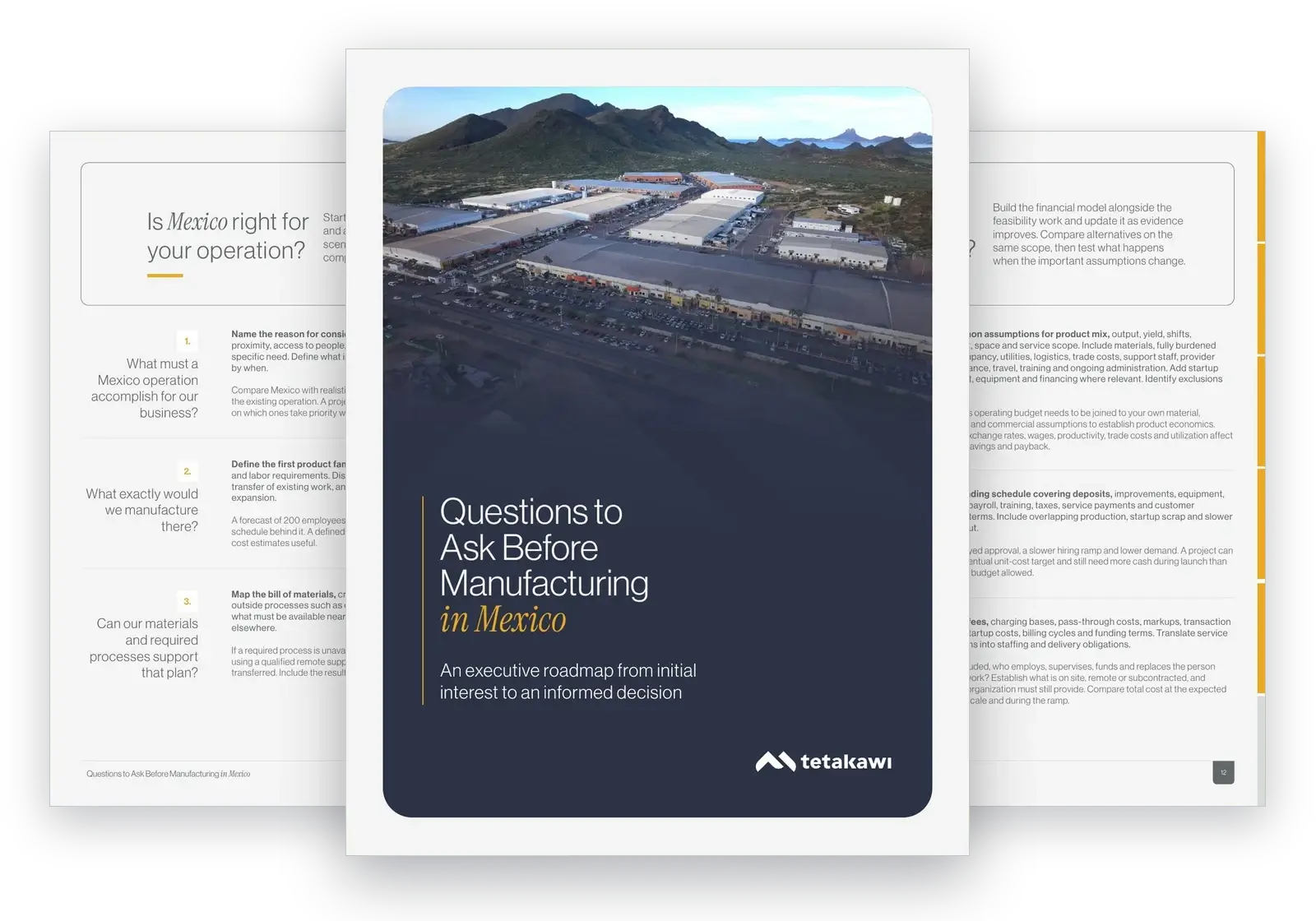
An executive roadmap from initial interest to an informed decision.
A Mexico operation rarely goes wrong on the decision. It goes wrong on something nobody raised until it was already a problem: a permit, a wage band, a customs classification, a utility that could not carry the load. This is the list to work through while changing your mind is still cheap.
Download it now. We will also email you a copy.






What’s Inside
The guide follows the decision in six parts, from whether Mexico fits your operation to what has to happen before the first shipment.
Start with the business problem and a defined production scenario, so every later comparison has a common basis.
Decide how you want to obtain manufacturing capacity, then the legal structure and the support around production.
Investigate trade treatment, facility requirements and economics together, on the same production scenario.
Evaluate specific locations against the requirements your operation cannot work without.
Compare alternatives on the same scope, then test what happens when the important assumptions change.
Replace the most consequential assumptions with evidence and give the remaining work clear owners.
Every question comes with guidance on what to define, what to confirm and what to compare. Work through it with the people who own operations, finance, engineering, supply chain and commercial commitments, from one production scenario.
Proof of Platform
Active manufacturers today
Employees supported
Manufacturing Campuses
sq ft under management
Years operating in Mexico
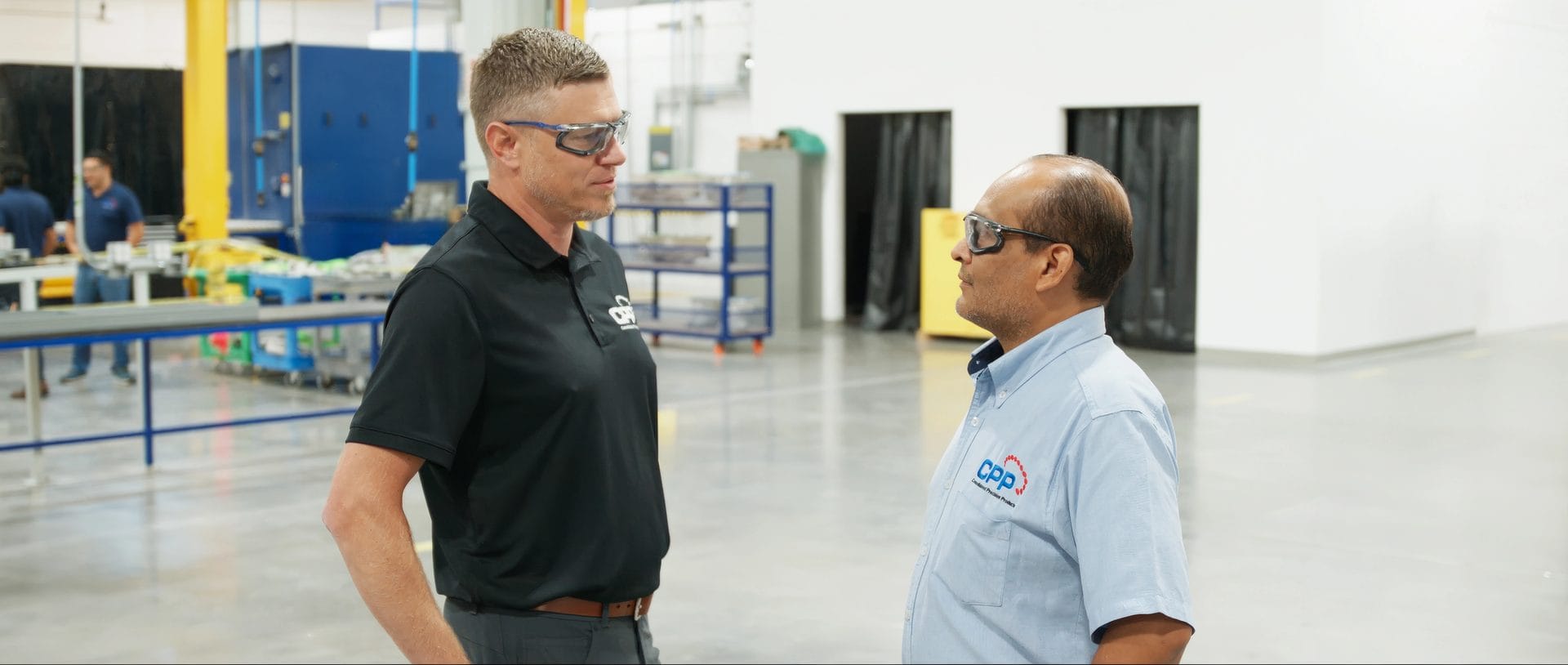

Jeremy Main, Senior Vice President, Consolidated Precision Products


Brian Berich, Director of Operations, BAE Systems


Ricardo Gómez, Director of Operations, TE Connectivity
FAQs
Short answers to the questions that come up before a Mexico decision. The guide goes deeper on each one.
It depends on the longest dependency in your plan, which may be customer approval and not the building. Work backward from the delivery date your customer needs: permits, equipment installation, recruiting, training, process validation and customer approval each take time. Access to a building is not readiness to manufacture or approval to ship. The last section of the guide maps the sequence.
More than the wage rate. A fair comparison uses the same product mix, output, shifts, headcount and space, then adds materials, fully burdened labor, occupancy, utilities, logistics, trade costs, support staff, training and administration. Then model the cash you need during launch, before output is stable. The economics section of the guide covers both.
It depends on how you sell, your tax position, your risk tolerance and your investment horizon. A standalone operation uses your own Mexican entity, and you build and maintain the local organization. Under a shelter arrangement, a provider supplies the legal and administrative framework while you direct manufacturing. The guide compares the two in its section on how the operation would work.
Yes, when you run your own factory. A contract manufacturer makes the product for you, with the control and intellectual-property arrangements that come with that. Running your own operation, standalone or under a shelter arrangement, keeps production management, process knowledge and quality execution with your team. It also takes management time. The guide covers which responsibilities your team retains.
Start with your operation. Rank what it cannot work without: skills, supplier access, customer proximity, freight routes, utilities and room to expand. Then check local evidence with the people who recruit, run plants and move freight there. National averages and an attractive building are starting points for research. The location section of the guide covers this.
Not by location alone. USMCA eligibility depends on the rule of origin for your product and the facts that support it. Manufacturing in Mexico, or operating under IMMEX, does not establish it by itself. Confirm the treatment your business case assumes before you rely on it. The trade section of the guide covers programs, tax and approvals.